Overview
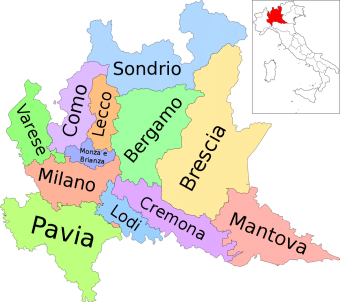
The province of Milan is the 2nd largest Italian province by population with 3.261.873 people, located in the Lombardy region.
The city of Milan, with 1,371,498 residents, is the second-most popolous city and industrial, commercial and financial capital of Italy.
Milan is a global center for fashion, design, and business. It is home to prestigious fashion houses, luxury brands, and renowned design studios.
The city hosts major international fashion events, including Milan Fashion Week.
Milan's financial district houses Italy's stock exchange and important financial institutions. The city is also rich in artistic and cultural heritage, with iconic landmarks such as the Milan Cathedral (Duomo di Milano), the Galleria Vittorio Emanuele II, and the Sforza Castle.
Additionally, Milan is known for its thriving nightlife, diverse culinary scene, and vibrant street markets.
The larger Milano metropolitan area comprises 133 towns (comuni) and covers an area of 1575 km2.
The population density is 2,071 inhabitants per km2, making it somewhat densely populated. The male to female ratio is 1.00:1.07.
Climate
The province of Milan receives on average 222 hours of sunshine per month, or 7.4 hours of sunshine per day.
This is 5.93% less than the average for Italy and 0.57% more than the average for the region of Lombardy.
Throughout the year, it rains on average 7.63 days per month, which is an ordinary amount of precipitation for an Italian province.
During the autumn and winter season, there are usually 11.84 days per month with fog and 2.77 cold days per month with perceived temperatures below 3°C. In the summer, there are on average 20.21 hot days per month with perceived temperatures above 30°C.
Weather Now
Milano, LombardiaCost of Living
The average monthly income in Milan is around 2549.55€, which is higher than the average for Italy.
The estimated cost of living is around 2741.87€ per month for an individual or 4087.62€ per month for a family of 4.
The cost for renting a small apartment (2-3 bedrooms) in a main city area is around 1584.79€ per month.
Overall, Milano is expensive compared to other Italian provinces.
Living in Milan is around 66.16% more expensive than the average of all Italian provinces.
Quality of Life
Healthcare
Healthcare in Milan is above average. For every 10k inhabitants, there are around 2.85 pharmacies, 7.47 general practitioners and 37.5 specialized doctors per 10k inhabitants.
Average life expectancy in Milan is very high at 82.2 years of age.
Education
Milan has a higher-than-average percentage of high school graduates, around 71.4%; and a higher-than-average percentage of university graduates, around 41.9%.
The average number of completed years of schooling for people over 25 is 11.63, which is above the national average of 10.44.
There are 8 universities within the province.
Leisure
Milan is renowned for its vibrant and world-class nightlife.
The city offers an extensive array of bars, clubs, and venues where visitors can enjoy an unforgettable night out.
From fashionable rooftop bars and stylish lounges to pulsating nightclubs, Milan caters to diverse tastes and preferences. The city's nightlife scene is known for its trendsetting atmosphere, cutting-edge music, and a vibrant mix of locals and international visitors.
Overall, Milan has pretty good nightlife with 2.98 bars and 3.72 restaurants per 10k inhabitants.
Crime and Safety
The province of Milan is overall less safe than other Italian provinces for expats. As of 2021, there are an average of 4866.3 reported crimes per 100k inhabitants. This is 71.60% higher than the national average.
There have been around 0.2 deadly road accidents and 5.2 serious work-related injuries per 10k people in Milano. This is respectively 62.96% less driving accidents than average and 59.69% less work accidents than average.
Car theft is reportedly 124.26% higher than average with 158.17 cases per 100k inhabitants.
Reports of house thefts are 14.26% higher than average with 199.97 cases per 100k inhabitants.
Cases of robbery are not totally uncommon, around 253.61% higher than average with 78.29 reports per 100k inhabitants.
Milan has experienced an increase in crime rate in the last couple of years. In 2021, Milan ranked first in terms of crime rate among North Italian cities.
Milan has seen an increase in several types of crimes, including property crimes such as theft and burglary, as well as violent crimes such as assault and robbery.
Pickpocketing and bag snatching are common in crowded areas such as train stations and tourist attractions, particularly during peak tourist season. Additionally, there has been an increase in drug-related crimes in certain parts of the city.
Despite the increase in crime rate, Milan is still considered a relatively safe city compared to other large European cities. The city maintains a strong police presence and has implemented effective safety measures such as surveillance cameras and increased lighting in certain areas. Visitors can also take measures to enhance their safety such as using well-lit and busy streets, avoiding isolated areas, and being cautious of strangers.
Transport
Public transport in Milan is quite good, and traffic is low.
There are on average 0.49 active vehicles per person, against a national average of 0.66. The city of Milano is one of the very few places in Italy with an urban metro system, the Metropolitana di Milano.
Around 0.47km per 10k inhabitants of the main city in Milano consist of bicycle lanes. This makes Milano not very bike-friendly.


