Overview
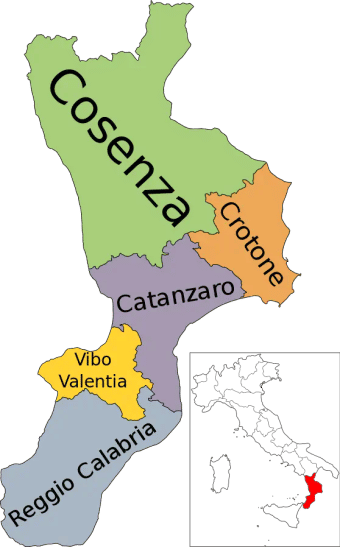
The province of Crotone is the 97th largest Italian province by population with 174.980 people, located in the Calabria region.
The city of Crotone, with a population of approximately 62,949 residents, is located on the Ionian Sea in the Calabria region of southern Italy.
With a rich history dating back to ancient times as a Greek colony, Crotone offers a unique blend of archaeological wonders and natural beauty.
Visitors can explore the Capo Colonna Archaeological Park, home to the remains of a Doric temple dedicated to Hera Lacinia. The city also boasts beautiful beaches, including Le Castella and Capo Rizzuto, where visitors can relax and enjoy the crystal-clear waters of the Ionian Sea.
The larger Crotone metropolitan area comprises 27 towns (comuni) and covers an area of 173.568 km2.
The population density is 101 inhabitants per km2, making it somewhat densely populated. The male to female ratio is 1.00:1.02.
Climate
The province of Crotone receives on average 267 hours of sunshine per month, or 8.9 hours of sunshine per day.
This is 13.14% more than the average for Italy and 5.70% more than the average for the region of Calabria.
Throughout the year, it rains on average 6.16 days per month, which is below average for an Italian province.
During the autumn and winter season, there are usually 1.02 days per month with fog and 0.2 cold days per month with perceived temperatures below 3°C. In the summer, there are on average 24.59 hot days per month with perceived temperatures above 30°C.
Weather Now
Crotone, CalabriaCost of Living
The average monthly income in Crotone is around 1137.42€, which is lower than the average for Italy.
The estimated cost of living is around 1278.37€ per month for an individual or 1902.62€ per month for a family of 4.
The cost for renting a small apartment (2-3 bedrooms) in a main city area is around 498.57€ per month.
Overall, Crotone is affordable compared to other Italian provinces.
Living in Crotone is around 22.53% cheaper than the average of all Italian provinces.
Quality of Life
Healthcare
Healthcare in Crotone is below average. For every 10k inhabitants, there are around 3.66 pharmacies, 8.88 general practitioners and 21.5 specialized doctors per 10k inhabitants.
Average life expectancy in Crotone is 81.1 years of age.
Education
Crotone has a lower-than-average percentage of high school graduates, around 44.7%; and a lower-than-average percentage of university graduates, around 14.6%.
The average number of completed years of schooling for people over 25 is 9.11, which is lower than the national average of 10.44.
There are no universities in this province.
Leisure
Crotone may be a smaller city, but it still offers a pleasant and laid-back nightlife experience.
Travelers can enjoy the local bars and pubs, which provide a cozy and friendly atmosphere.
While not as bustling as larger cities, Crotone's nightlife scene allows visitors to unwind, socialize with locals, and enjoy the city's charm at a more relaxed pace.
Overall, Crotone has somewhat decent nightlife with 2.65 bars and 3.93 restaurants per 10k inhabitants.
Crime and Safety
The province of Crotone is overall moderately safe for expats. As of 2021, there are an average of 2792.3 reported crimes per 100k inhabitants. This is 1.53% lower than the national average.
There have been around 0.2 deadly road accidents and 16.2 serious work-related injuries per 10k people in Crotone. This is respectively 62.96% less driving accidents than average and -25.58% less work accidents than average.
Car theft is reportedly 17.78% lower than average with only 57.99 cases per 100k inhabitants.
Reports of house thefts are 38.76% lower than average with 107.19 cases per 100k inhabitants.
Cases of robbery are uncommon with 107.19 reported cases per 100k inhabitants, about 47.06% less the national average.
Overall, Crotone is quite safe to live and travel to.
Transport
Public transport in Crotone is lacking, and traffic is below average.
There are on average 0.62 active vehicles per person, against a national average of 0.66.
Around 0.24km per 10k inhabitants of the main city in Crotone consist of bicycle lanes. This makes Crotone not very bike-friendly.


