Overview
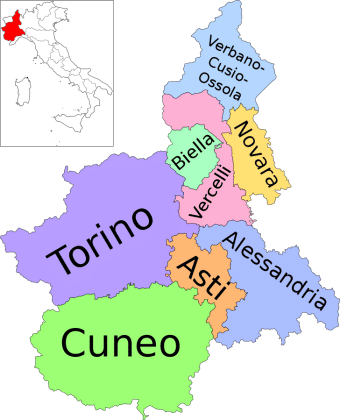
The province of Biella is the 96th largest Italian province by population with 177.585 people, located in the Piedmont region.
The larger Biella metropolitan area comprises 74 towns (comuni) and covers an area of 91.328 km2.
The population density is 192 inhabitants per km2, making it somewhat densely populated. The male to female ratio is 1.00:1.09.
Climate
The province of Biella receives on average 216 hours of sunshine per month, or 7.2 hours of sunshine per day.
This is 8.47% less than the average for Italy and 2.70% less than the average for the region of Piedmont.
Throughout the year, it rains on average 8.69 days per month, which is well above average for an Italian province.
During the autumn and winter season, there are usually 0.2 days per month with fog and 4.52 cold days per month with perceived temperatures below 3°C. In the summer, there are on average 12.92 hot days per month with perceived temperatures above 30°C.
Weather Now
Biella, PiemonteCost of Living
The average monthly income in Biella is around 1918.93€, which is higher than the average for Italy.
The estimated cost of living is around 1695.8€ per month for an individual or 2568.76€ per month for a family of 4.
The cost for renting a small apartment (2-3 bedrooms) in a main city area is around 768.41€ per month.
Overall, Biella is expensive compared to other Italian provinces.
Living in Biella is around 2.77% more expensive than the average of all Italian provinces.
Quality of Life
Healthcare
Healthcare in Biella is above average. For every 10k inhabitants, there are around 4.02 pharmacies, 8.15 general practitioners and 21.8 specialized doctors per 10k inhabitants.
Average life expectancy in Biella is 81.2 years of age.
Education
Biella has a lower-than-average percentage of high school graduates, around 58.4%; and a higher-than-average percentage of university graduates, around 28.8%.
The average number of completed years of schooling for people over 25 is 10.23, which is not far from the national average of 10.44.
There are no universities in this province.
Leisure
Overall, Biella has somewhat decent nightlife with 3.11 bars and 3.38 restaurants per 10k inhabitants.
Crime and Safety
The province of Biella is overall very safe for expats. As of 2021, there are an average of 2517.4 reported crimes per 100k inhabitants. This is 11.23% lower than the national average.
There have been around 0.3 deadly road accidents and 4.9 serious work-related injuries per 10k people in Biella. This is respectively 44.44% less driving accidents than average and 62.02% less work accidents than average.
Car theft is reportedly 76.42% lower than average with only 16.63 cases per 100k inhabitants.
Reports of house thefts are 24.64% lower than average with 131.89 cases per 100k inhabitants.
Cases of robbery are uncommon with 131.89 reported cases per 100k inhabitants, about 19.69% less the national average.
Biella generally maintains a low crime rate. However, visitors should still exercise caution and follow standard safety practices. Being aware of your surroundings, particularly in crowded areas, and securing personal belongings can contribute to a safe and enjoyable experience in Biella.
Transport
Public transport in Biella is lacking, and traffic is very high.
There are on average 0.72 active vehicles per person, against a national average of 0.66.
Around 0.85km per 10k inhabitants of the main city in Biella consist of bicycle lanes. This makes Biella somewhat bike-friendly by Italian standards.
The town is not large, and most of the sights can be seen comfortably on foot. Getting to Biella Piazzo (the upper town) can be quite tiring on foot. The Biella funicular (funicolare) connects a lower station on Via Curiel, in the city's Biella Piano quarter, with an upper station on Via Avogadro in the city's medieval Biella Piazzo quarter.


